The Best Beaches in Lofoten: An Honest Guide from Local HostsThe Best Beaches in Lofoten: An Honest Guide from Local Hosts
Which Lofoten beaches are worth your time — and when? Local hosts in the west sort them by effort and season, with parking and practical detail.Which Lofoten beaches are worth your time — and when? Local hosts in the west sort them by effort and season, with parking and practical detail.
The first time guests see a Lofoten beach, the reaction is almost always the same:
"This cannot be the Arctic."
White sand. Turquoise water. Mountains rising straight out of the sea behind you.
And then they put a foot in the water, and the second reaction follows quickly.
It is the Arctic.
This guide answers one question: which beaches are actually worth your time — and when?
Because here is what most beach lists won't tell you. The beaches of Lofoten are not interchangeable. Some you park beside; some you earn with a hike; one you can only reach by boat. Some face the midnight sun; others sit in shadow at midnight. And several of the best ones are at their most remarkable in October or February, when the lists have stopped talking about beaches altogether.
We live in the west of Lofoten, a few minutes from several of the beaches below, and we visit them in every season. This is how we would explain them to a friend.
First, three honest facts about Lofoten beaches
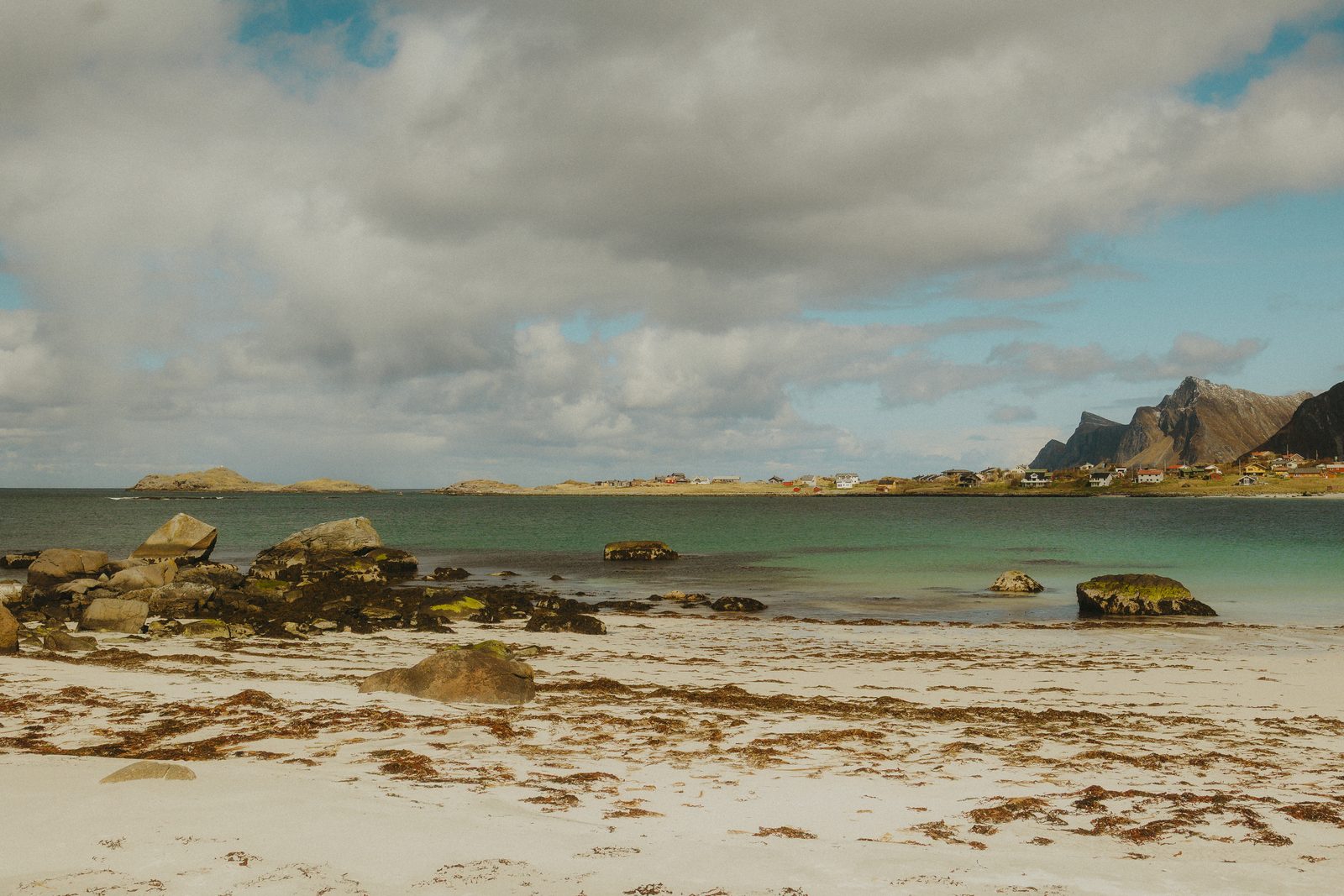
1. Yes, you can swim. The sea is at its least cold in late summer — roughly 9–15 °C at its very warmest. Locals swim; guests swim; children splash at the edge for longer than their parents believe possible. But it is a dip, not a Mediterranean afternoon. You go in, you come out, and you feel extraordinary.
2. The beach day here is not a sunbathing day. It is a walk, a swim if you dare, a fire in an established fire pit, a long evening in low light. In summer the light barely leaves; the long, light nights mean a beach at 23:00 can be the best beach of your trip.
3. Beaches are a year-round reason to be here. In autumn, storm light turns them into the most dramatic places on the islands. In winter, a white beach under a dark sky is one of the best aurora foregrounds anywhere. If you only think of beaches as a summer subject, you will miss half of what they do.
Did you know? — from Casa Lofoten
The swim is easier when a hot sauna is waiting. Our guests' most-loved ritual — mentioned in most of our reviews — is the beach-and-sauna combination on our own shore: sauna, a few steps of sand, the fjord, and back into the heat. As one guest put it: "The morning sauna with a dip in the ice-cold sea guarantees a good start to the day." (translated) → The sauna and the beach
How to choose: sort by effort, not by fame
Every beach below is worth visiting. The real question is what it costs you to get there — and what you get for that effort.
- Drive-to beaches: Rambergstranda, Skagsanden, Brunstranda, Yttersand, Haukland, Uttakleiv. Park, walk a minute, you are there. These are the beaches for families, short stops and changeable weather.
- Hike-to beach: Kvalvika. A proper walk in, and a reward that matches it.
- Boat-to beach: Bunes. A passenger boat, a village with no road, and the biggest sweep of sand in the west.
Our honest rule: on a short trip, pick one from each group rather than trying to tick all of them. A beach deserves hours, not a photo stop. One or two experiences a day is the pace this landscape rewards.
The drive-to beaches
Rambergstranda — the one by the village
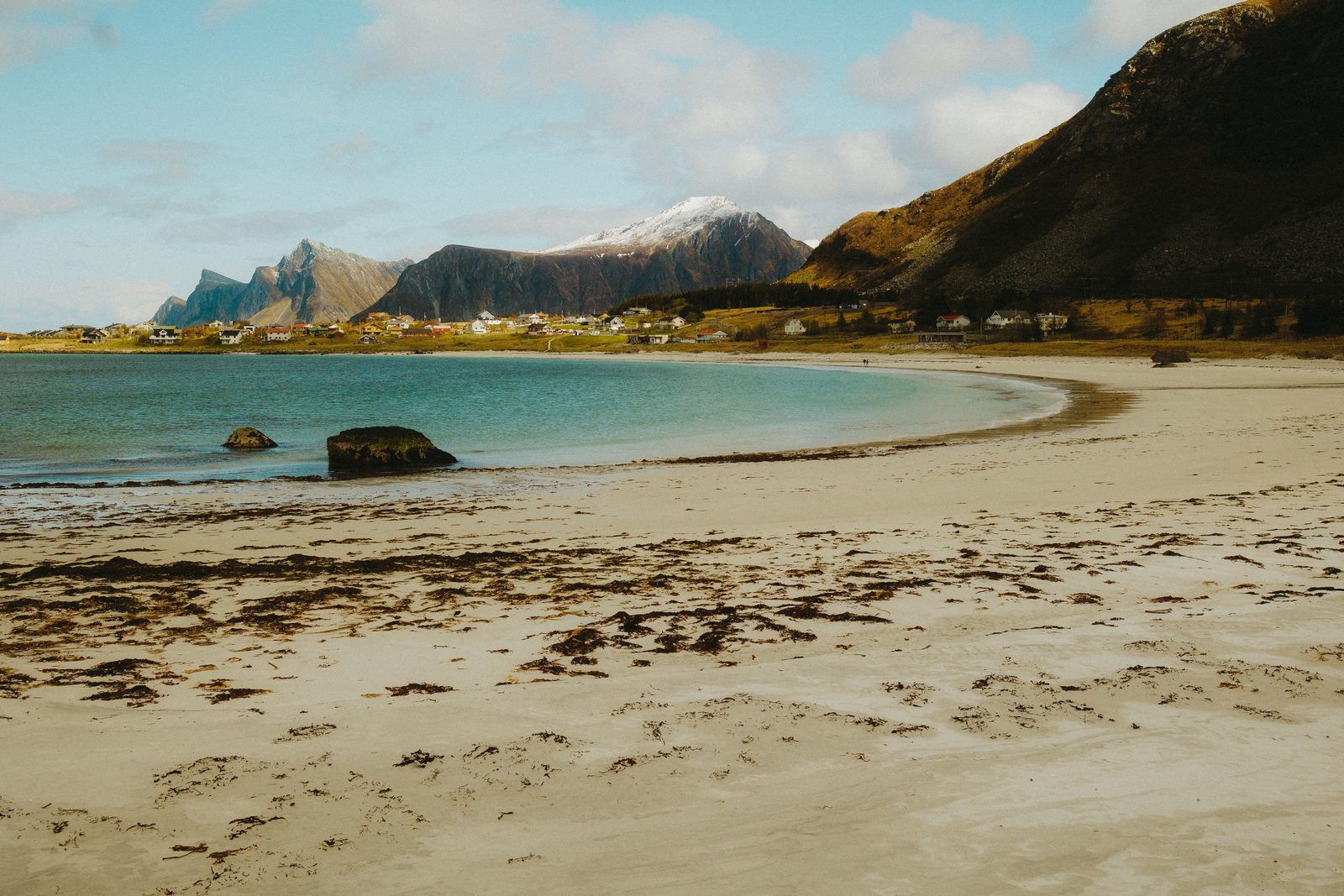
A long, crescent-shaped sweep of chalk-white sand, directly beside the village of Ramberg on the E10. You can see it from the road; you can park and be on the sand in a minute; the village shop is a few minutes away for supplies.
What makes it special is the orientation. Rambergstranda faces west — which makes it one of the best midnight sun beaches in Lofoten. From late May to mid-July, the sun swings low across the sea in front of you through the evening, and the beach holds the light long after most of the islands have gone into shadow.
It is also the easiest "first beach" of a trip: no walk, no fee stress, a village behind you. If you arrive in the west in the afternoon and want to understand immediately why you came, start here.
Practical: parking by the village, facilities in Ramberg itself. Works in every season — in winter the snow meets the sand, which is a sight in its own right.
→ More detail on our Rambergstranda page.
Skagsanden — the photographers' beach
A few minutes further along the E10, by the distinctive Flakstad church, lies Skagsanden. At first glance it is a flatter, plainer beach than its neighbours. Then the tide goes out.
The retreating water leaves patterns in the dark-and-light sand — ripples and stream braids that photographers travel across the world for. Add a mountain reflected in the wet sand, or the aurora above it from mid-September onwards, and you understand why on some evenings the tripods outnumber the people.
You do not need a camera to enjoy it. Walk it at low tide and read the patterns with your feet.
Practical: parking by the beach; check current signage for fees. Best moments: low tide, and the hours of low light.
© COPYRIGHT MÅ AVKLARES — Skagsanden med tidevannsmønstre, Flakstad kirke bak (nett: 68north.com) — alternativ: eget foto, 20–30 min unna
Brunstranda — the surf beach two minutes from Ramberg
Just east of Ramberg — about two minutes by car — is Brunstranda, home of the Lofoten Beach Camp. This is where you surf in the west: courses, board and wetsuit rental, a beach bar in season, and a sauna by the sand.
Two things surprise people here. First, that surfing in the Arctic is not a stunt — it is a real, established scene. Second, the calendar: summer has the mildest water and the gentlest waves, which makes it the beginners' season, while winter brings the biggest storm swells and the best surf — for experienced surfers in full winter wetsuits, hoods, gloves and boots.
Even if you never touch a board, a coffee here watching surfers in falling snow is a genuinely Lofoten experience.
Practical: everything runs through Lofoten Beach Camp; check season opening times.
Yttersand — the quiet one
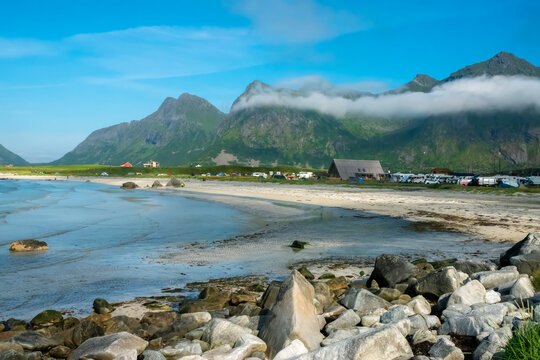
Cross the Fredvang bridges — themselves one of the west's famous sights — and continue to the end of the road, and you reach Yttersand: a wide, calm beach that most visitors drive straight past because it is not on their list.
That is precisely its value. On days when the famous beaches are busy, Yttersand often is not. From the beach, an easy coastal walk continues along the shore — the same fine, flat walking as the beach itself, out and back the way you came.
Practical: small parking by the beach; no facilities — bring what you need and take everything back out.
Haukland — the classic
Haukland is the beach that wins the "most beautiful in Norway" polls, and it earns them: a sheltered bay of white sand and vivid blue-green water, ringed by peaks. It sits on Vestvågøya, about 25–30 minutes' drive from Ramberg — for a west-based trip, this is your natural day-trip beach.
It is also the best-equipped beach in Lofoten: a visitor centre with a café, toilets and showers in season, and parking directly at the sand. That makes it the obvious choice for families who want a full, easy beach day.
From the north end of the beach, a coastal path rounds the headland to Uttakleiv — a walk of roughly two kilometres each way along the sea, and one of the finest easy walks on the islands. (Sources disagree on the exact distance; we will measure it ourselves and update this guide.)
Practical: paid parking (rates change — pay by app or machine), café and facilities seasonal. Arrive early on fine summer days; the car park fills.
Temporary: the Nappstraumen tunnel works (until December 2027)
The undersea Nappstraumtunnelen — the E10’s only link between Leknes and the west of Lofoten — is being upgraded through the end of 2027. During work periods, daytime traffic passes in convoys behind a lead car, and the tunnel closes at night (roughly 23:00–06:00) with only limited let-throughs; queues can add up to an hour. The works pause around Christmas and for a period each summer. Check current convoy and closing times in the Statens vegvesen traffic app when you plan late or early drives.
Uttakleiv — the wild neighbour
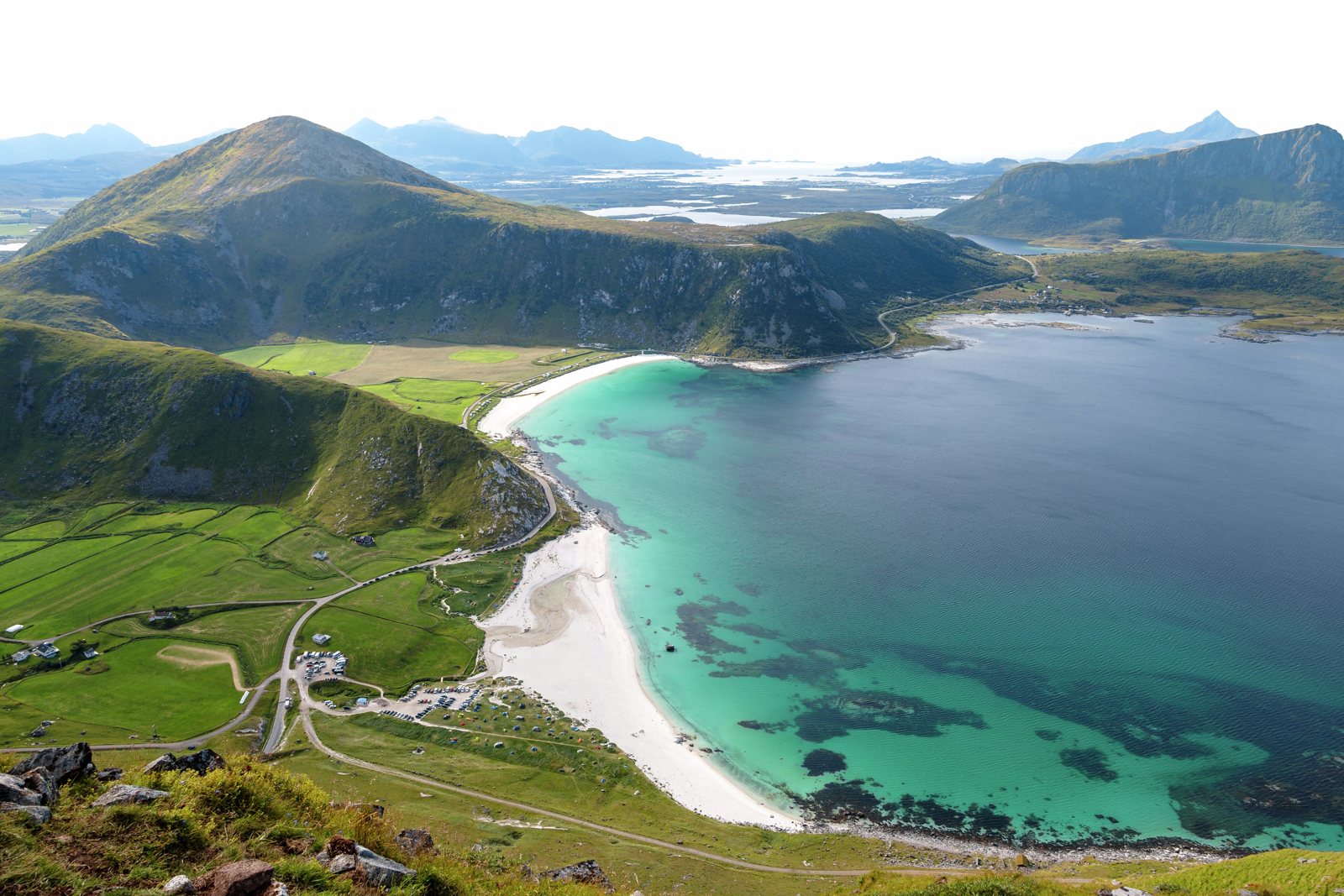
Through the tunnel from Haukland (cars only — walkers take the coastal path) lies Uttakleiv, and the two could not feel more different. Where Haukland is a sheltered, gentle bay, Uttakleiv is open coast: sand mixed with fields of rounded boulders, an enormous sky, and the sea coming at you with nothing in the way.
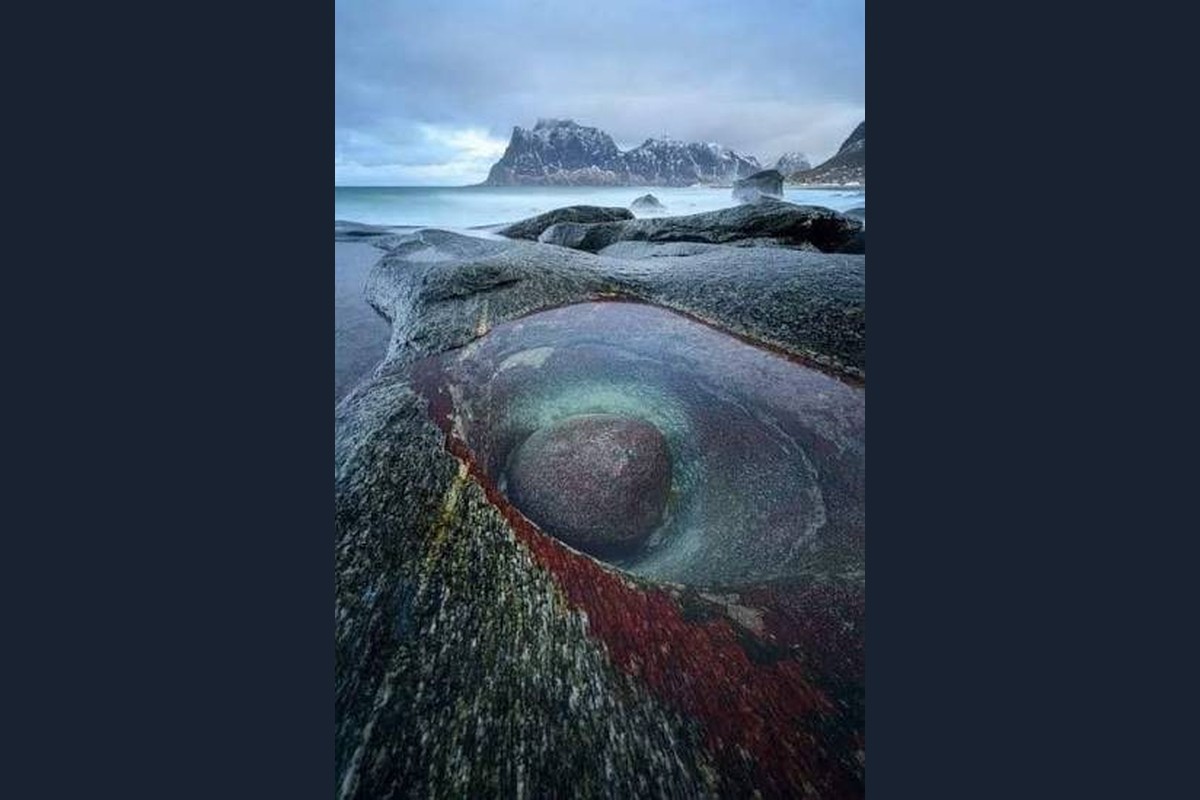
This is probably the most photographed beach in Lofoten. The smooth stones — including the famous heart-shaped "eye" pool — the open horizon and the exposed light have made it a fixture of every serious landscape photographer's itinerary, in summer for the low evening sun and in winter for the aurora.
Practical: one small paid car park (roadside parking is forbidden and fined); toilets; a basic camping area. Come for the last hours of light rather than the middle of the day.
The hike-to beach
Kvalvika — the beach you earn
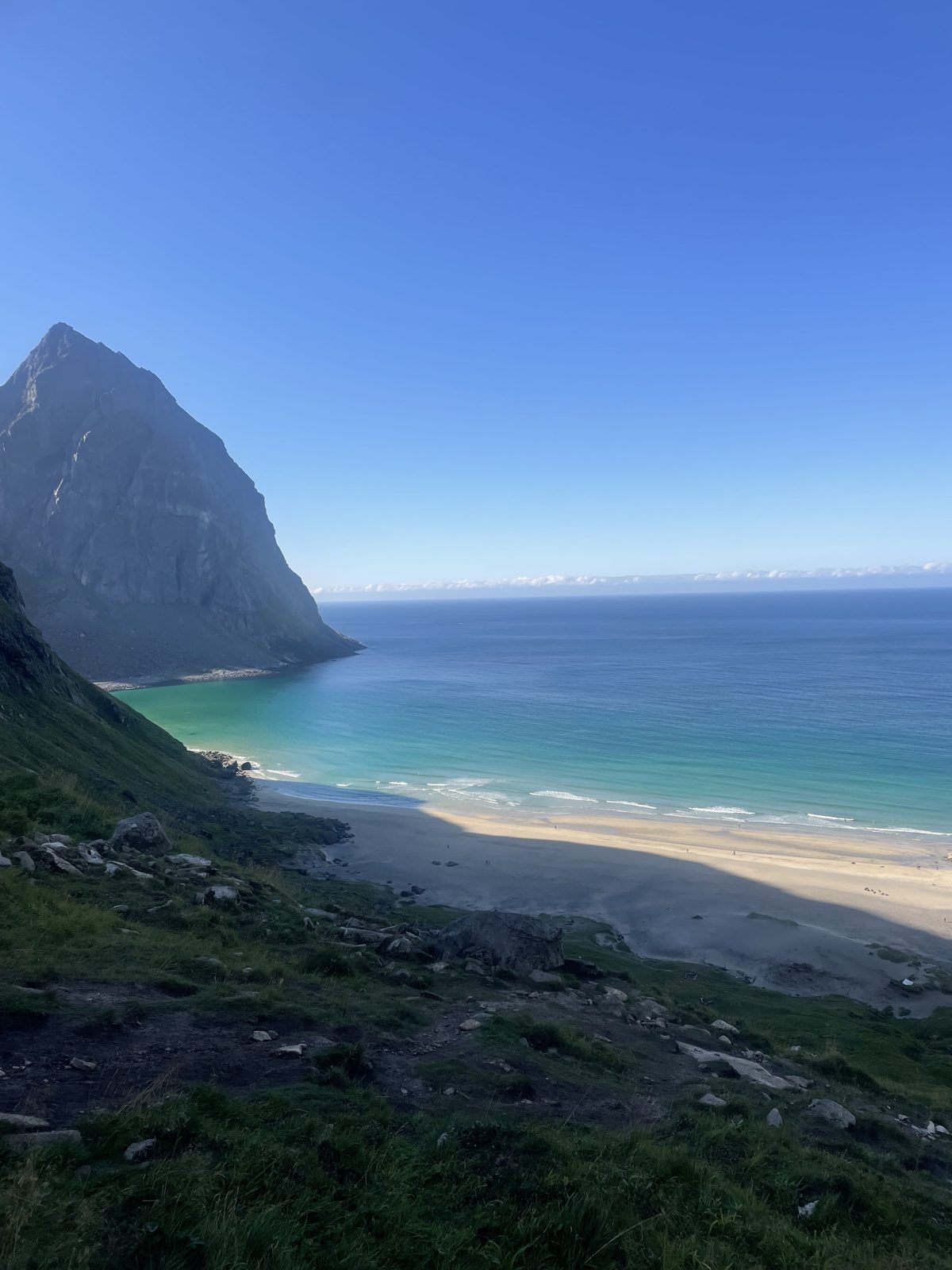
Kvalvika cannot be reached by road. That single fact has kept it what it is: a wide, wild double bay of white sand inside Lofotodden National Park, backed by cliffs, facing the open sea.
There are two ways in, and the honest advice is to choose by parking as much as by trail:
- From Torsfjorden: the shortest walk — about 2 km each way over a low pass of roughly 180 metres, with boardwalks over the boggy sections and a stony final descent where hands help. But the parking here is limited, fills early in summer, and wrong parking is fined. If it is full, do not improvise — drive on.
- From the Innersand side (the Yttersand road): about 3 km each way with roughly 260 metres of climbing, on a good path with boardwalks. Same trailhead area as the Ryten hike, so you can combine them.
The combination is the point for many: climb Ryten first and look down on Kvalvika from above — one of the most famous views in Norway — then descend to the sand. From a base in the west, the trailheads are only about 15–20 minutes' drive from Ramberg, which is why locals treat Kvalvika as an evening walk, not an expedition.
Allow a half day, wear proper footwear, and bring everything you need — there are no facilities, and everything you carry in comes back out with you.
Trail numbers above are approximate; see our Kvalvika Beach and Ryten pages for the full, current detail.
The boat-to beach
Bunes — sand at the end of the fjord
Bunes is the west's grand finale: an enormous flat sweep of sand at the head of the Reinefjord, walled in by cliffs, inside Lofotodden National Park. There is no road. You take the small passenger boat from Reine — about 20 minutes up a fjord that would justify the ticket on its own — step off in the roadless village of Vindstad, and walk an easy, well-marked path of about 3 km (roughly 45 minutes) over a low pass to the beach.
Then the pass opens, and the scale of the place stops people mid-step.
Three practical truths decide whether this day works:
- Book the boat. In summer the departures fill; book ahead through the Reis Nordland or EnTur apps rather than queueing on the pier.
- Know your return time. Miss the last boat and you are spending the night in Vindstad. Write the departure time on your hand if you must.
- There is nothing at the beach. No café, no toilets, no shelter. Bring what you need; take everything back.
From a base in the west, Reine is 25–30 minutes away, which makes Bunes a comfortable full-day plan rather than a logistical feat.
Its neighbour Horseid — reached with the same boat, a different stop and a longer walk — is emptier still, for those who want the same idea with even fewer people.
Boat times and prices change by season — check the current Reinefjord timetable before you plan the day.
© COPYRIGHT MÅ AVKLARES — Bunes-stranda fra passet (nett: 68north.com) — alternativ: eget foto ved neste Reine-tur
Beaches through the year
Late May to mid-July — the midnight sun. To watch the midnight sun from a beach, the geometry matters: at midnight the sun sits low toward the north, having swung there across the west through the evening. West-facing Rambergstranda holds that long evening light beautifully, and the open-horizon beaches — Uttakleiv, Yttersand, Kvalvika — carry it deep into the night. There is no closing time on any of them; the long, light nights are exactly when the beaches are at their best and quietest.
Did you know? — from Casa Lofoten
Our dock has chairs facing the evening sea for exactly this reason — the midnight sun watched from your own shore, kettle within reach. → The property
September and October — the storm shows. Autumn light on a Lofoten beach is unlike anything in summer: fast, dramatic, constantly changing. The first aurora nights arrive from mid-September, and Skagsanden's wet-sand reflections come into their own. This is our favourite season to have a beach almost alone.
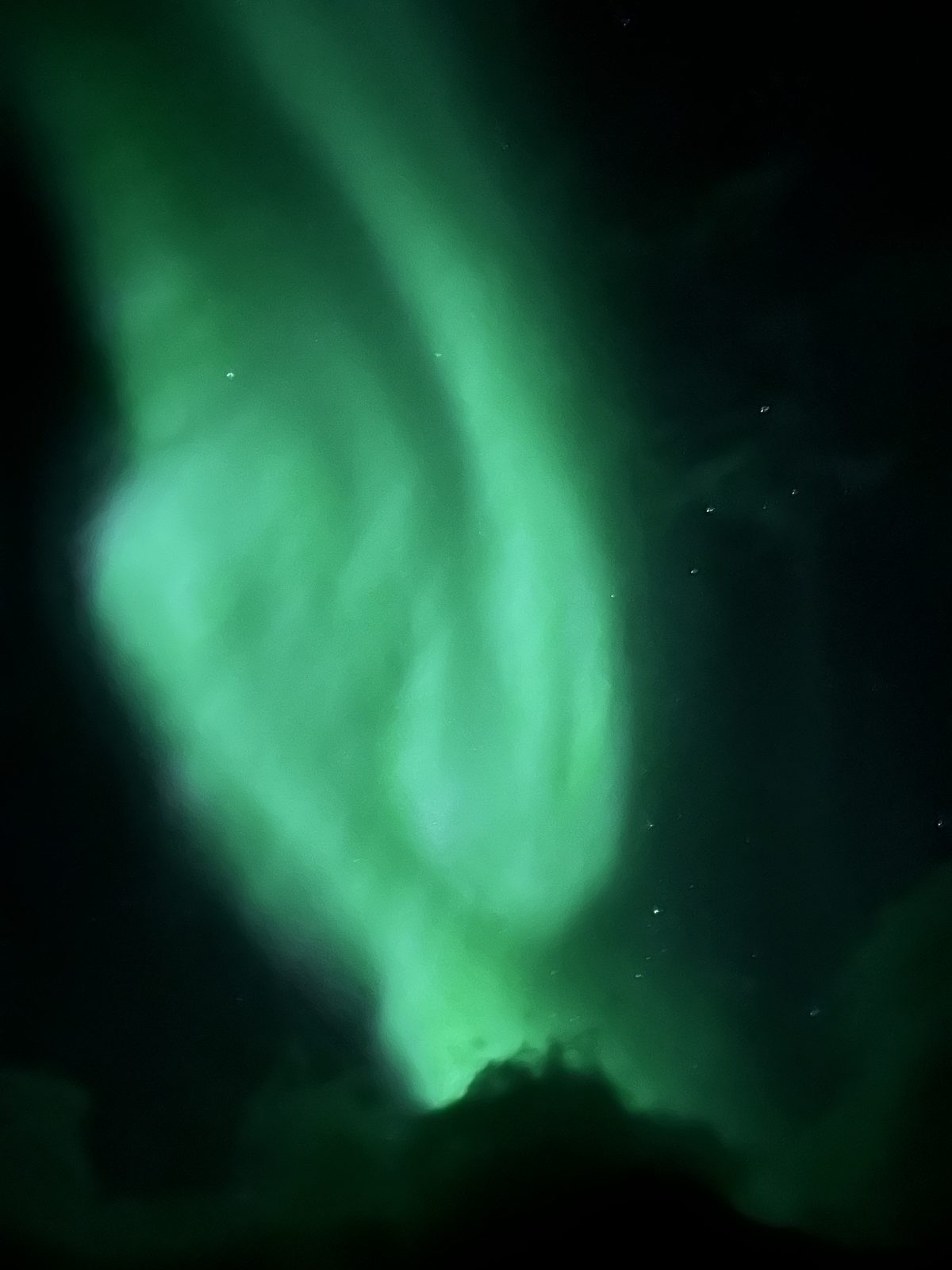
Winter — white sand under white snow. A beach in winter sounds like a contradiction until you stand on one: snow down to the tideline, sea smoke over the water, and on clear nights the aurora with sand underfoot. Two rules from our northern lights guide apply doubly on beaches: bring a headlamp for the walk in, and once you are there, step 20 metres away from any light and let your eyes adjust. And remember the local saying — there is no bad weather, only bad clothing.
Practical notes for all of them
Parking is the one thing that goes wrong. The famous beaches now have organised, mostly paid parking — and active enforcement of everything else. Never park on road verges or in passing places, even "just for a photo": fines are real, and the narrow roads genuinely need those spaces. If a car park is full, that beach is full; go to the next one. Rates change yearly, so pay whatever the app or machine at the site says rather than what a blog remembered.
Leave no trace. Several of these beaches sit in or beside Lofotodden National Park. Use established fire pits, take every scrap of litter out (including what others left, if you are feeling generous), and give nesting birds and grazing sheep their space.
The weather will change while you are there. Pack a windproof layer for every beach visit, in every month. A beach that was calm at the car park can be a wind tunnel at the waterline — and half an hour later, calm again. This is part of the experience, not a flaw in it.
Frequently asked questions
Can you actually swim at Lofoten beaches?
Yes. The sea is at its least cold in late summer — roughly 9–15 °C at its warmest — and a swim is genuinely possible for anyone willing. Treat it as a dip with a warm layer waiting, not a long swim.
Which beach is best with children?
Haukland for a full day (facilities, café, sheltered bay), Rambergstranda for ease (village beside it, sand in a minute from the car). Kvalvika works well for families who are comfortable with a real walk — children usually love the boardwalks.
Which beaches have toilets?
Haukland (visitor centre, in season) and Uttakleiv (basic). The rest have little or nothing — plan accordingly, especially for Kvalvika and Bunes.
Which beach should we choose in bad weather?
Skagsanden and Uttakleiv are at their most dramatic in rough conditions — from a safe distance up the sand. Save the sheltered, gentle beach days at Haukland and Rambergstranda for calmer weather. Never turn your back on big surf.
Can we see the northern lights from a beach?
From mid-September through the winter, yes — beaches are among the best aurora foregrounds because of their open horizons and darkness. Bring a headlamp for the walk, then move away from every light source and give your eyes time.
Do we need a car to reach these beaches?
Realistically, yes — the beaches are spread along the road and buses are sparse. See our guide: Do You Need a Car in Lofoten?
Is one day enough for the beaches?
One day gives you one drive-to beach done properly, or Kvalvika, or Bunes. A week in the west lets you take them at the pace they deserve. There isn't a version of this trip where rushing improves it.
The beach at the door
Our own sand beach faces the fjord a few steps from the sauna door — the swim-and-sauna ritual our guests mention more than anything else.